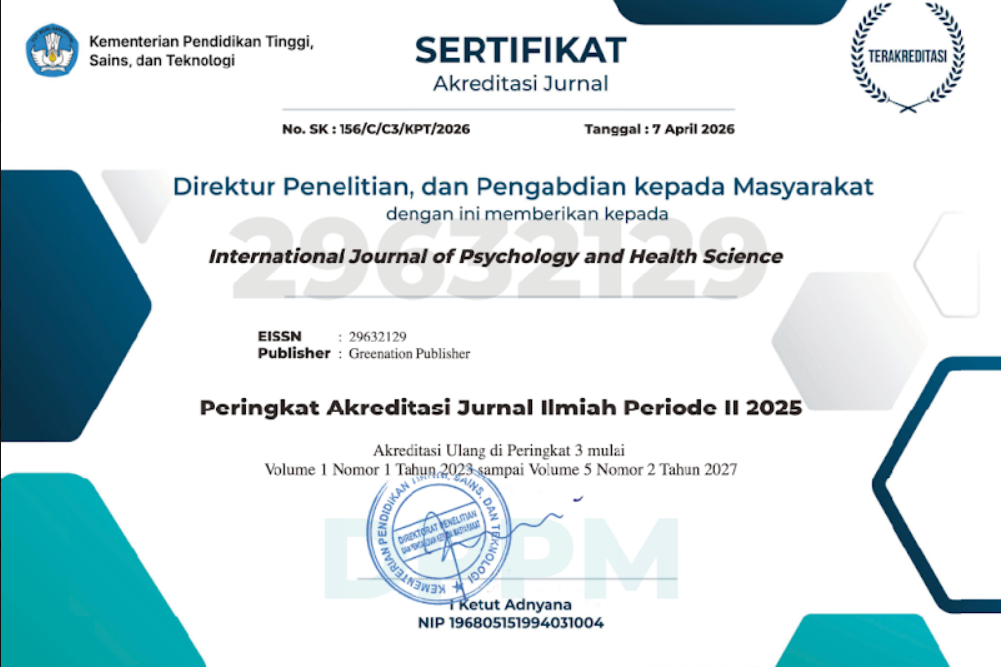
Accreditation SINTA 3

The publication ethics of the International Journal of Psychology and Health Science (IJPHS) are based on the Core Practices and guidance of the Committee on Publication Ethics (COPE). This statement applies to editors, reviewers, and authors.
Publication Ethics and Malpractice Statement Form. As a journal in psychology and health science, IJPHS requires all authors to complete and sign the Publication Ethics and Malpractice Statement Form and upload it as a supplementary file at submission. Manuscripts submitted without the completed form will not be processed.
Contents
Publication decisions. The Editor-in-Chief decides which submitted manuscripts are published, based on originality, clarity, scientific contribution, and relevance to the journal's scope, taking into account reviewers' reports and legal requirements regarding libel, copyright infringement, and plagiarism. The Editor-in-Chief may consult other editors or reviewers.
Fair play. Manuscripts are evaluated on their intellectual content without regard to the authors' race, gender, sexual orientation, religious belief, ethnic origin, citizenship, or political views.
Confidentiality. Editors do not disclose information about a submitted manuscript to anyone other than the corresponding author, reviewers, potential reviewers, editorial advisers, and the publisher, as appropriate.
Use of unpublished material. Unpublished material disclosed in a submitted manuscript must not be used in an editor's own research without the author's written consent.
No coercive citation. Editors must not require authors to cite IJPHS articles as a condition of acceptance. Suggested references are made only when directly relevant to the manuscript.
Commercial independence. Advertising, reprint, or other commercial revenue has no influence on editorial decisions.
Handling ethical complaints. Editors respond to every ethical complaint about a submitted or published article, including those raised years after publication, in accordance with the Research Misconduct Policy.
Contribution to editorial decisions. Peer review assists editors in making decisions and helps authors improve their manuscripts.
Promptness. A reviewer who feels unqualified or unable to complete the review on time must notify the editor and withdraw.
Confidentiality. Manuscripts under review are confidential documents and must not be discussed with others unless authorized by the editor.
Objectivity. Reviews are conducted objectively and supported by clear arguments. Personal criticism of authors is inappropriate.
Acknowledgement of sources. Reviewers identify relevant published work that has not been cited and inform the editor of any substantial similarity or overlap with other published work.
Conflict of interest. See Section 5.
Reporting standards. Authors present an accurate account of the work and an objective discussion of its significance, with sufficient detail and references to permit replication. Fraudulent or knowingly inaccurate statements constitute unethical behaviour.
Data access and retention. Authors may be asked to provide raw data for editorial review and should retain it for at least ten years after publication, while protecting participants' confidentiality.
Originality and plagiarism. Authors submit only original work and properly cite the work and words of others, in accordance with the Plagiarism Policy.
Multiple or redundant publication. The same research must not be published in more than one journal, and the same manuscript must not be submitted to more than one journal simultaneously.
Research ethics. Research involving human participants must obtain approval from an appropriate ethics committee and informed consent from participants, and this must be stated in the manuscript and declared in the Publication Ethics and Malpractice Statement Form. Any unusual hazards involved in the procedures or equipment used must be clearly identified.
Use of AI. The use of artificial intelligence tools must be disclosed in accordance with the AI Statement.
Authorship, conflict of interest, and errors in published work are governed by Sections 4, 5, and 6.
IJPHS follows the authorship criteria recommended by the ICMJE and COPE. A person qualifies as an author only if they meet all four of the following criteria:
Contributors who do not meet all four criteria (for example, funders, language editors, or technical assistants) are listed in the Acknowledgment section, not as authors.
The corresponding author ensures that all eligible authors are included, that no ineligible person is listed, and that all authors have approved the final manuscript and its submission to IJPHS.
Not permitted: ghost authorship (omitting a substantial contributor), gift or guest authorship (listing a non-contributor), and buying, selling, or adding author slots.
Changes to authorship (addition, removal, or reordering) are permitted only before acceptance, through a written request to the editor stating the reason and signed consent from all authors, including any author being removed. After publication, changes can only be made through a correction notice (Section 6).
AI tools cannot be listed as authors because they cannot take responsibility for the work.
A conflict of interest is any financial, institutional, or personal interest that could influence, or appear to influence, the objectivity of research, review, or editorial decisions. IJPHS requires all parties to disclose such interests.
Undisclosed conflicts of interest discovered later are handled as alleged misconduct under the Research Misconduct Policy.
A published article is the version of record and is never altered or removed silently. Any change is made transparently, following the COPE Retraction Guidelines:
| Mechanism | Used when |
|---|---|
| Erratum | An error was introduced by the journal during the publication process (e.g., author names, affiliations, tables, or layout). |
| Corrigendum | An error was made by the authors but does not affect the main findings and conclusions. |
| Expression of Concern | There are serious concerns about the reliability of an article, but the investigation is not yet concluded. |
| Retraction | The findings are unreliable (major error, fabrication, or falsification), or there is plagiarism, redundant publication, unethical research, or manipulation of peer review. |
Procedure:
Readers may submit comments, critiques, or scientific questions about published articles as a Letter to the Editor sent to [journal email] with the subject "Comment on Article – [article title, DOI]", within 12 months of publication and in no more than 1,000 words.
References
Committee on Publication Ethics (COPE). Core Practices. https://publicationethics.org/core-practices
Committee on Publication Ethics (COPE). Retraction Guidelines. https://publicationethics.org/guidance/Guideline/retraction-guidelines
Jl. Kapt. A. Hasan, Telanaipura, Jambi, Provinsi Jambi
The International Journal of Psychology and Health Science (IJPHS) is published and managed by Yayasan Global Research National through its Green Publisher department, in collaboration with Universitas Winaya Mukti (UNWIM Journal Publisher), Bandung. Yayasan Global Research National (GREENATION), is registered with the Directorate General of General Law Administration, Ministry of Law of the Republic of Indonesia, under Number SP: AHU-0009609.AH.01.04.Tahun 2020 (online), AHU-0009609.AH.01.04.Tahun 2020 (offline), dated June 22, 2020. In addition, IJPHS collaborates with the following institutions in Indonesia and the Philippines: Universitas Muhammadiyah Jakarta, Akademi Kebidanan Bunda Auni, Perkumpulan Perguruan Tinggi Administrasi RS Indonesia (PPT-ARSI), Universitas Perintis Indonesia, Universitas Sains dan Teknologi Indonesia, Universitas Baiturrahim, Mindanao State University, Universidad de Manila, Joseph College of Sindangan Incorporated, Vincent’s College Incorporated, Colegio de San Francisco Javier of Rizal Zamboanga Del Norte Incorporated, Saint Estanislao Kostka College Incorporated, Rizal Memorial Institute of Dapitan City Incorporated, and Philippine Association of Graduate Education – Region 9.