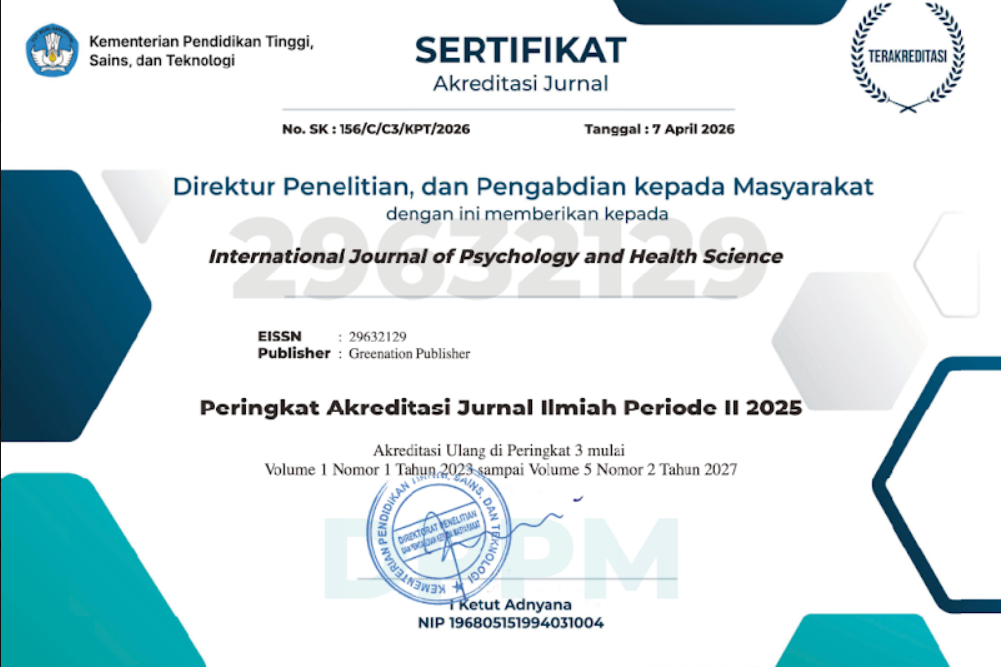
Accreditation SINTA 3

The Editorial Board of the International Journal of Psychology and Health Science (IJPHS) does not tolerate plagiarism or any other form of research misconduct. This page sets out the plagiarism policy and the procedure for handling allegations of research misconduct.
Contents
Definition. Plagiarism is the use of another person's words, ideas, data, or results, including the author's own previously published work, presented as original without proper acknowledgement.
Similarity screening. All submitted manuscripts and final versions are screened with Turnitin. The maximum permitted similarity index is 25%, excluding references, quotations, and properly cited material. Manuscripts above this limit are returned to the authors for revision and re-screened before further processing. The journal may conduct additional originality checks at any stage.
Requirements:
| Level | Description | Action |
|---|---|---|
| Minor | Limited uncited wording, with no significant data or ideas taken from another work. | Authors revise the text and add proper citations; the manuscript may then be reconsidered. |
| Intermediate | Substantial uncited overlap with other work. | The manuscript may be rejected, and the authors may be barred from submitting for a period determined by the Editorial Board. |
| Severe | Extensive appropriation of another's work, results, or ideas, or simultaneous submission to another journal. | The manuscript is rejected, and the authors are barred from submitting for a period determined by the Editorial Board. If discovered after publication, the article is handled under Corrections and Retractions. |
IJPHS handles every allegation of research or publication misconduct fairly and confidentially, following the COPE flowcharts. This policy applies to manuscripts under consideration and to published articles, whenever the misconduct is discovered.
Forms of misconduct covered include:
How to report. Anyone (readers, reviewers, editors, or others) may report suspected misconduct to [journal email] with the subject "Misconduct Report – [article title]". The report should identify the article, describe the concern, and include supporting evidence. The identity of the reporter is kept confidential. Anonymous reports are considered if supported by sufficient evidence.
Procedure:
Possible outcomes, depending on severity: revision or rejection of the manuscript; correction, expression of concern, or retraction of a published article; notification of the authors' institution or funder; and a submission ban in accordance with the table of actions.
Jl. Kapt. A. Hasan, Telanaipura, Jambi, Provinsi Jambi
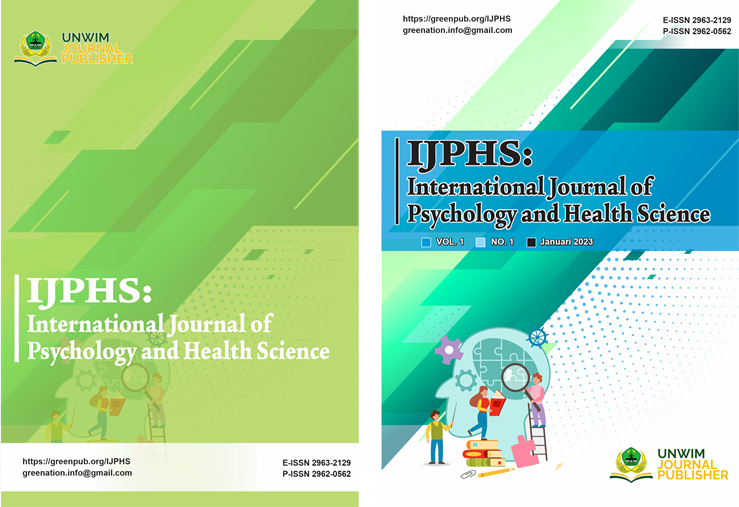
The International Journal of Psychology and Health Science (IJPHS) is published and managed by Yayasan Global Research National through its Green Publisher department, in collaboration with Universitas Winaya Mukti (UNWIM Journal Publisher), Bandung. Yayasan Global Research National (GREENATION), is registered with the Directorate General of General Law Administration, Ministry of Law of the Republic of Indonesia, under Number SP: AHU-0009609.AH.01.04.Tahun 2020 (online), AHU-0009609.AH.01.04.Tahun 2020 (offline), dated June 22, 2020. In addition, IJPHS collaborates with the following institutions in Indonesia and the Philippines: Universitas Muhammadiyah Jakarta, Akademi Kebidanan Bunda Auni, Perkumpulan Perguruan Tinggi Administrasi RS Indonesia (PPT-ARSI), Universitas Perintis Indonesia, Universitas Sains dan Teknologi Indonesia, Universitas Baiturrahim, Mindanao State University, Universidad de Manila, Joseph College of Sindangan Incorporated, Vincent’s College Incorporated, Colegio de San Francisco Javier of Rizal Zamboanga Del Norte Incorporated, Saint Estanislao Kostka College Incorporated, Rizal Memorial Institute of Dapitan City Incorporated, and Philippine Association of Graduate Education – Region 9.